I participated in the CyCTF 2025 competition, which featured various challenges. This write-up covers one of the challenges I successfully solved. I’ll explain my approach, the steps I took, and how I ultimately captured the flag.
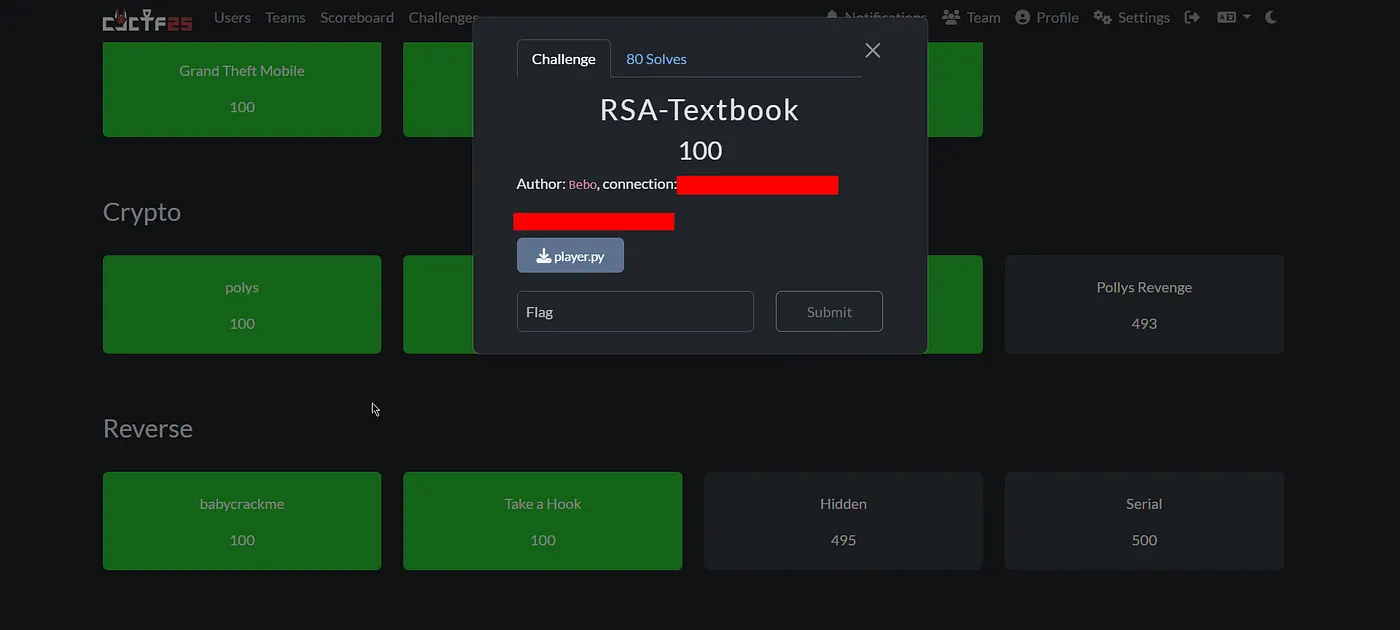
Category: Cryptography
Author: Bebo
Provided Information
- server remote connection
"player.py"(source)
# player.py
from Crypto.Util.number import *
def genkey(bits):
  e=0x100001
  p=getPrime(bits)
  q=getPrime(bits)
  n=p*q
  phi=(p-1)*(q-1)
  d=pow(e,-1,phi)
  return (n,e),(p,q,d)
#flag must be bigger than 512 bit at least
flag=bytes_to_long(b'CYCTF{test_dummy}')
pub,priv=genkey(256)
n,e=pub
print(flag.bit_length())
print(pow(flag,e,n))
print(pub)
print(priv[-1]%(priv[1]-1))
Pretty straightforward RSA key generation, except for one suspicious line:
print(priv[-1] % (priv[1] - 1))This prints **d mod (q-1)** — and that’s all the info I needed to factor the modulus.
Server output
the server prints the encrypted flag and a small menu:
375
5444611832356613062376602094688849531995550481755386491698662666918004320372976242169200823346079981613940372584223468323699051883150333869019693645730659
(9555649878924561187791342872323911928342747324219852887068863922860608935379931428803892571462298607616590900032525527545271001633499501017292137794013951, 1048577)
61205136010498910026121562252890199738318883824907719425131454866540459789713
That corresponds to:
bitlen_flag = 375c = 5444...5730659→ ciphertext(n, e)→ RSA public keydq = 6120...589713→ leaked value
What’s Happening
In normal RSA, the private exponent d satisfies:

But here, we only know:
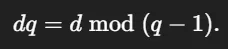
Substitute that into the original congruence mod (q−1):

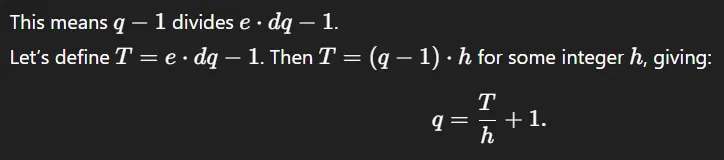
By brute-forcing small h values (or divisors of T), we can find the correct q.
Once q divides n, we have both primes and can decrypt the ciphertext.
Exploit plan
- Parse values from the server:
n, e, c, dq. - Compute
T = e * dq - 1. - Loop through small
hvalues:
for h in range(1, 1 << 26):
    if T % h == 0:
        q = T // h + 1
        if n % q == 0:
# found the correct q- Once found:
p = n // qphi = (p-1)*(q-1)d = inverse(e, phi)m = pow(c, d, n)
- Convert
mto bytes → flag.
Exploit script
from Crypto.Util.number import long_to_bytes
import math
# server-provided values
n = 9555649878924561187791342872323911928342747324219852887068863922860608935379931428803892571462298607616590900032525527545271001633499501017292137794013951
e = 1048577
dq = 61205136010498910026121562252890199738318883824907719425131454866540459789713
c = 5444611832356613062376602094688849531995550481755386491698662666918004320372976242169200823346079981613940372584223468323699051883150333869019693645730659
T = e * dq - 1
# brute-force small divisors h of T (h < e; in practice h is small)
q = None
for h in range(1, 1<<22):         # search range used; adjust upward if needed
    if T % h == 0:
        cand = T // h + 1
        if n % cand == 0:
            q = cand
            found_h = h
            break
p = n // q
# compute private exponent and decrypt
phi = (p-1)*(q-1)
d = pow(e, -1, phi)
m = pow(c, d, n)
print(long_to_bytes(m))
Flag reveal
After running the script, this is the output:
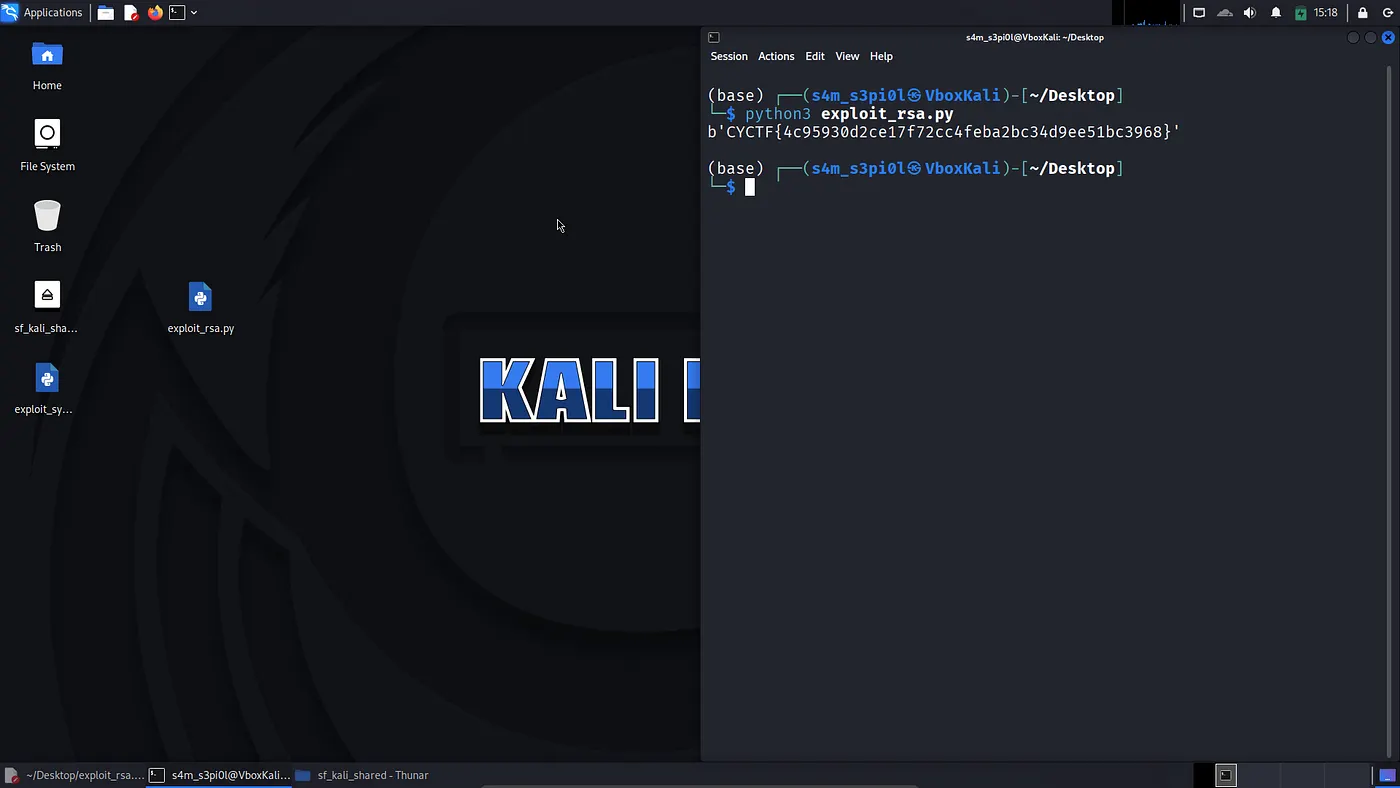
and voila, here is the flag🥳✅:
CYCTF{4c95930d2ce17f72cc4feba2bc34d9ee51bc3968}THANK YOU FOR READING!🫶