I participated in the CyCTF 2025 competition, which featured various challenges. This write-up covers one of the challenges I successfully solved. I’ll explain my approach, the steps I took, and how I ultimately captured the flag.
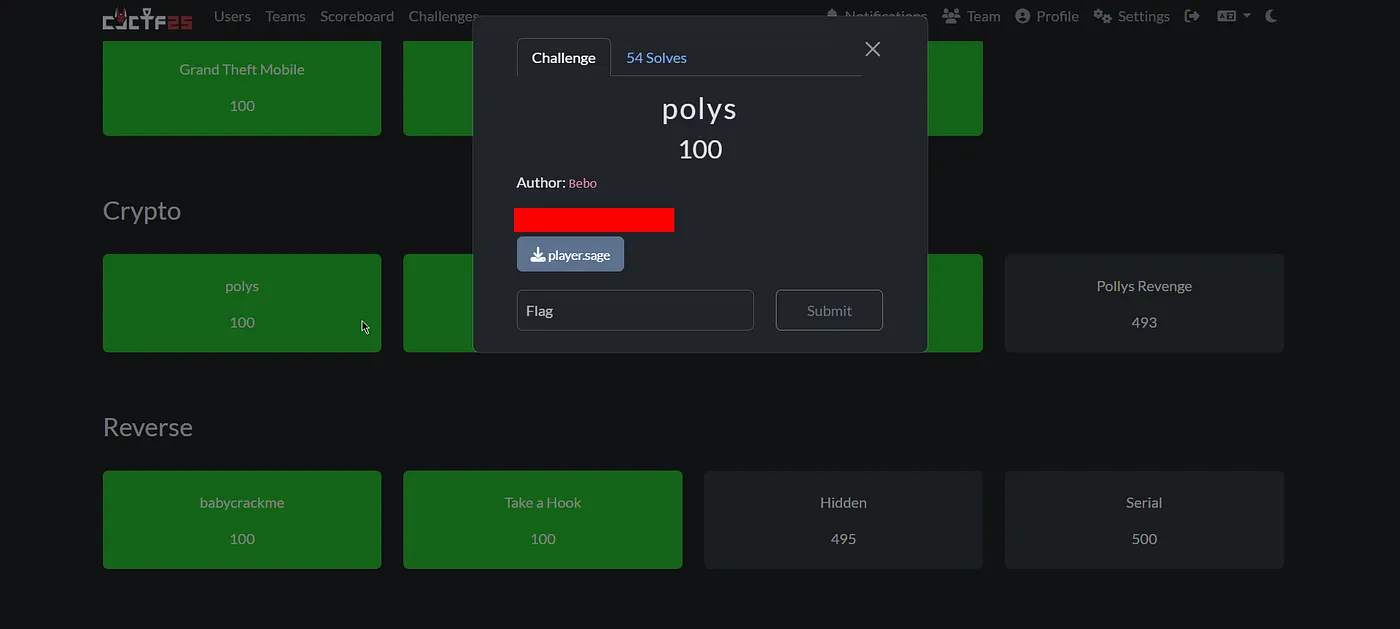
Category: Cryptography
Author: Bebo
Provided Information
- server remote connection
"player.sage"(source)
# player.sage
from Crypto.Util.number import getPrime, bytes_to_long
import random
p = getPrime(128)
flag = bytes_to_long(b'nothing_just_some_random_polys')
rr = flag.bit_length()
ff = []
for i in range(0, rr, rr//5):
    ff.append(flag % 2**(rr//5))
    flag >>= rr//5
print(p)
print(ff)
F = GF(p)
R.<x> = PolynomialRing(F)
poly1 = prod(x + r for r in ff)
for i in range(400):
    f = R.random_element(random.randint(1,8))
    poly1 *= f
print(poly1.degree())
while True:
    coff1 = input('enter list of coff of the modular equation:').split(',')
    coff1 = list(map(int, coff1))
    poly = R(coff1)
    print(poly)
    print(poly1 % poly)
Server output
And when connecting to the server we got this output:
239258953283630358806550621305969019917
[6537308465486925816189, 21366863478306246108806, 26074820876388456040641, 5168596814191753081521, 19914716372836213281555]
1742
enter list of coff of the modular equation:
Understanding the code
The code builds a polynomial over a finite field GF(p) as:

Then multiplies it by 400 random low-degree polynomials, just to bloat the degree and hide the real roots.
Those five numbers in the list ff are actually chunks of the flag encoded as integers.
Each chunk is a fixed bit-size slice of the long integer version of the flag.
What the prime (p) does
The prime p defines the finite field where all coefficients and operations happen.
Every polynomial coefficient and arithmetic operation is done modulo p.
This guarantees:
- arithmetic is well-defined (no zero divisors)
- factorization and GCD algorithms work cleanly
- and every number except 0 has a multiplicative inverse
So (p) basically tells Sage to work inside:

instead of the integers.
Exploitation
The challenge was supposed to let you interact and query remainders (poly1 % poly) to guess roots.
But in our case the server printed ff directly — the five integers that encode the flag.
That leak makes it trivial: we can simply reconstruct the original flag locally.
Each chunk represents a continuous bit range of the flag integer.
To rebuild, we concatenate those chunks back by shifting them by the correct number of bits.
from Crypto.Util.number import long_to_bytes
ff = [6537308465486925816189, 21366863478306246108806,
      26074820876388456040641, 5168596814191753081521,
      19914716372836213281555]
# determine bits per chunk
chunk_bits = max(f.bit_length() for f in ff)
flag_int = sum(ff[i] << (i * chunk_bits) for i in range(len(ff)))
print(long_to_bytes(flag_int))
Flag reveal
After running the script, this is the output:
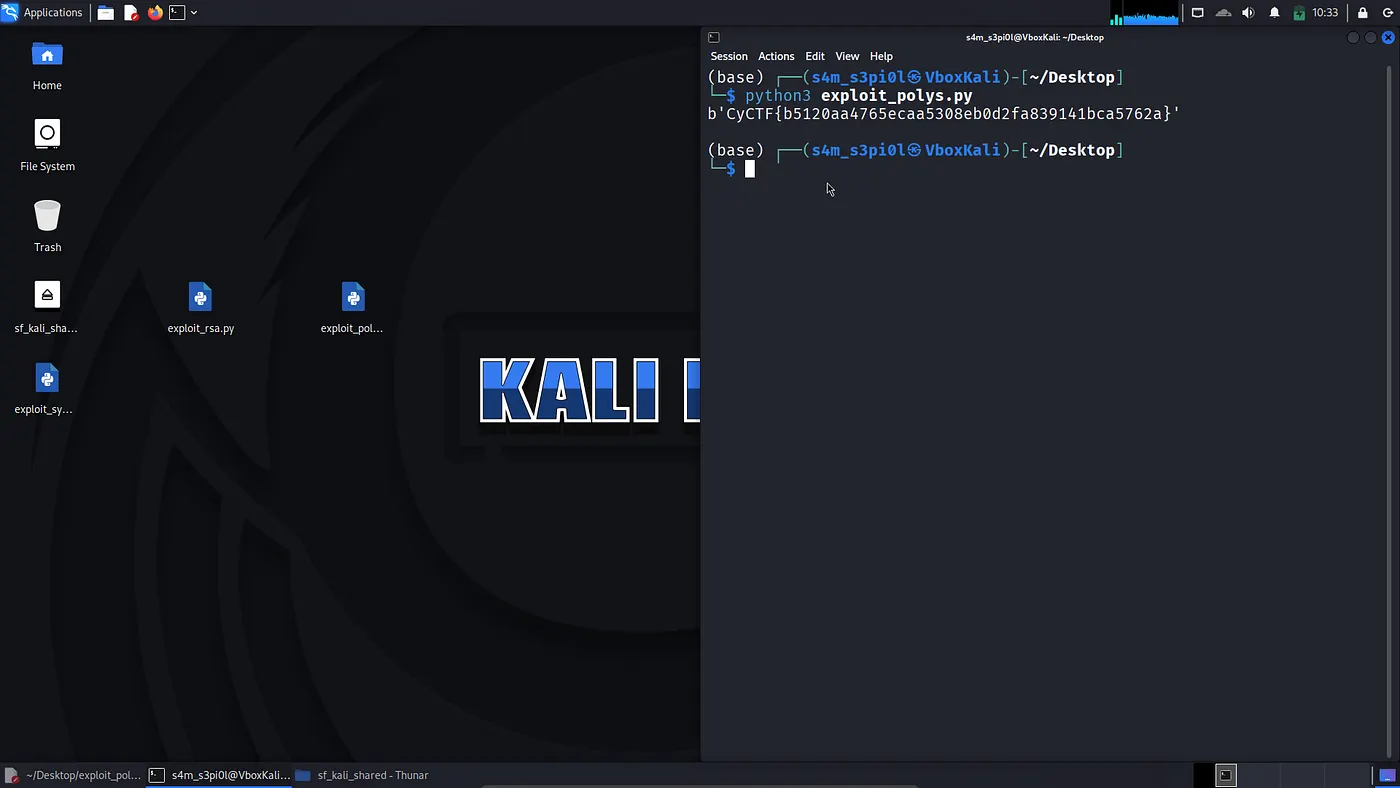
and voila, here is the flag🥳✅:
CyCTF{b5120aa4765ecaa5308eb0d2fa839141bca5762a}Now that we solved this challenge, Polys , it lead us to this:

But that’s a story for another time.
THANK YOU FOR READING!🫶